Media to the rescue
The global audience is hungering for meaningful content - you should make it

The Reuters Institute put out a detailed report on digital news media this week.
It had some telling charts on news consumption.
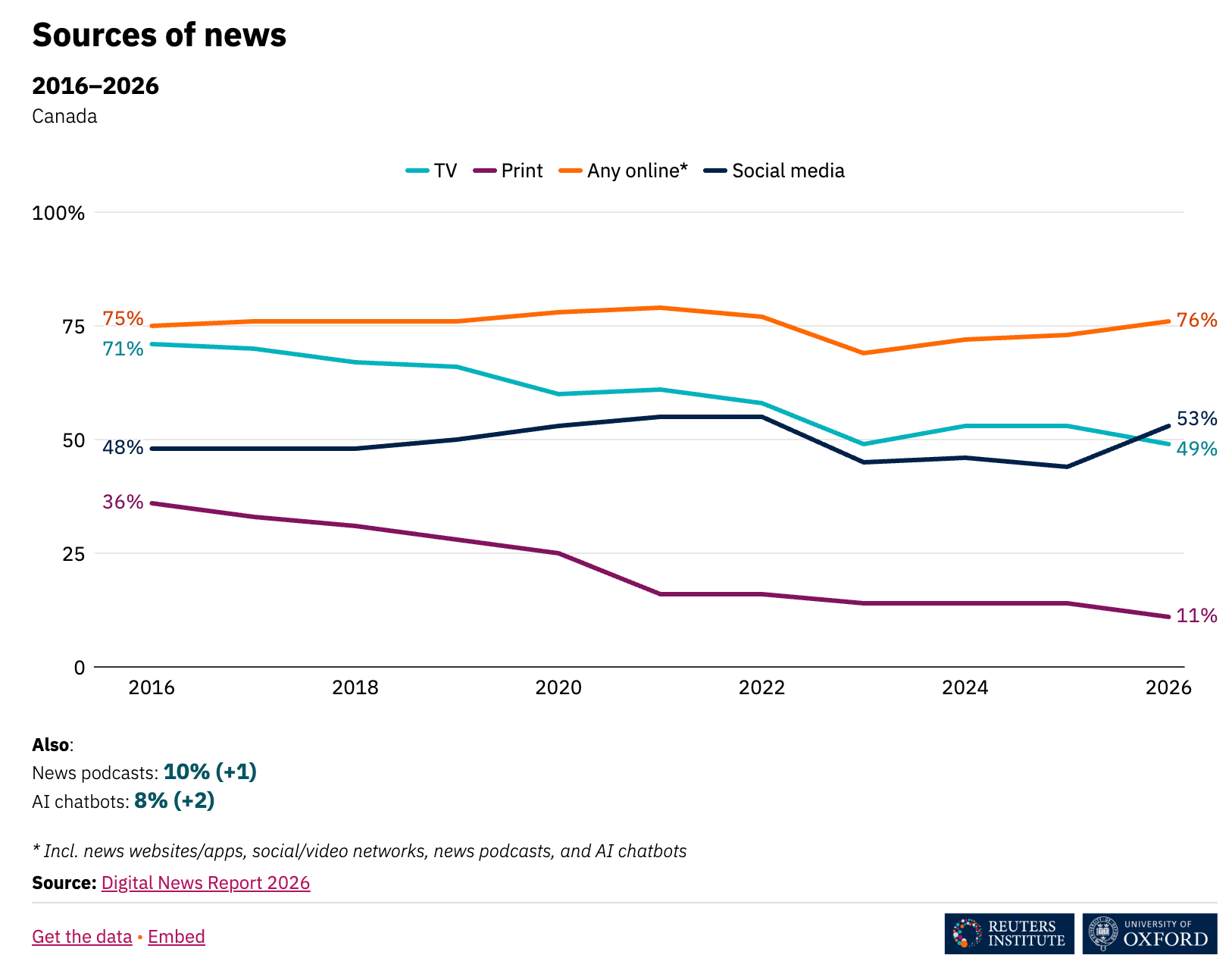
Here’s their data on Canada: “online” audiences are pretty solid over the past 10 years - although what that means has changed.
TV has declined about as precipitously as print.
Social media is up, although not massively - about half of Canadians get their news there, which is amazing since Meta has essentially gone to war with journalism during this time.
The big growth? News podcasts and AI chatbots now represent 18% of Canadian’s news sources. These didn’t really exist as a category until recently, and they are growing.
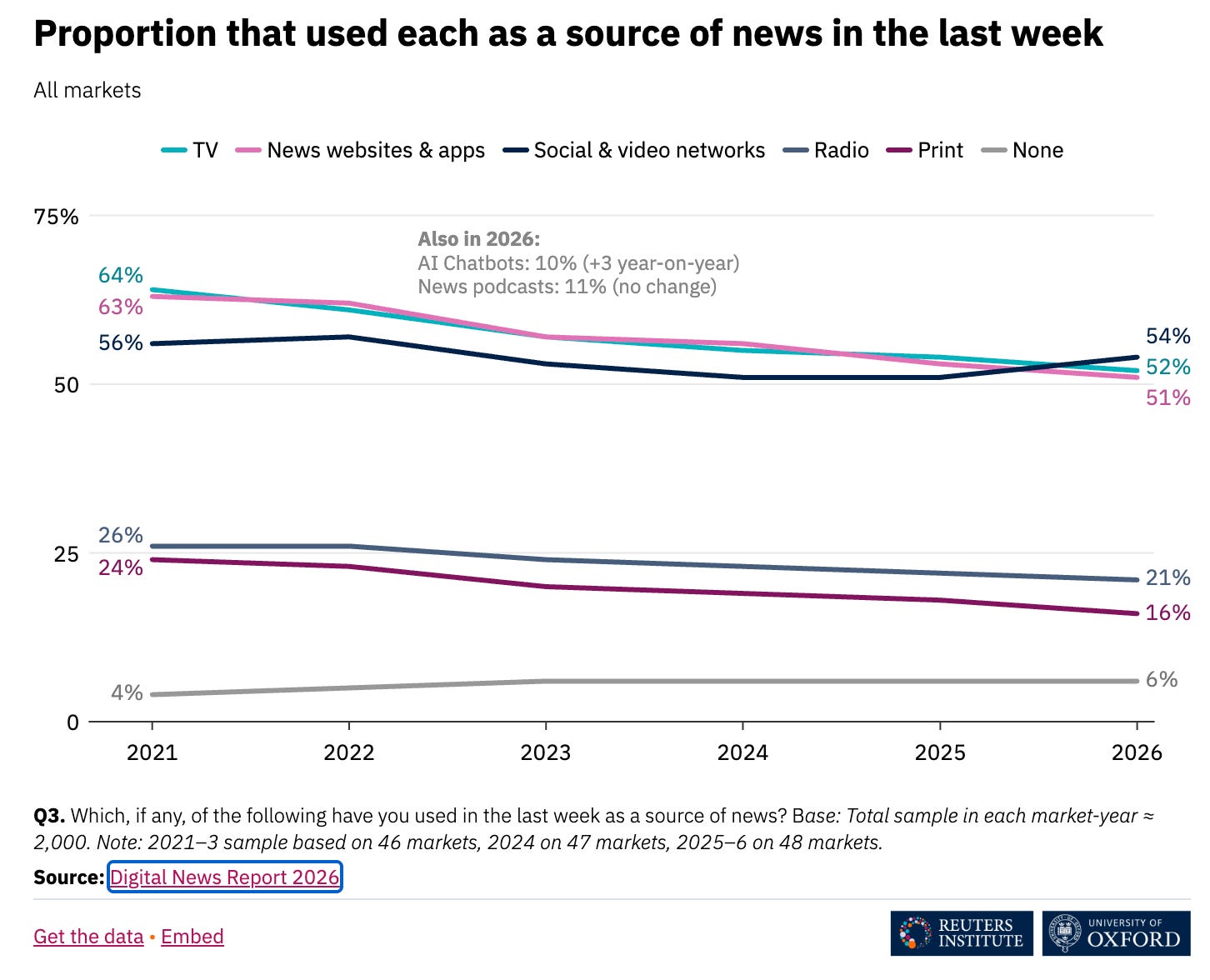
Globally, the usage number for news pods and AI chatbots is even higher - at 21%.
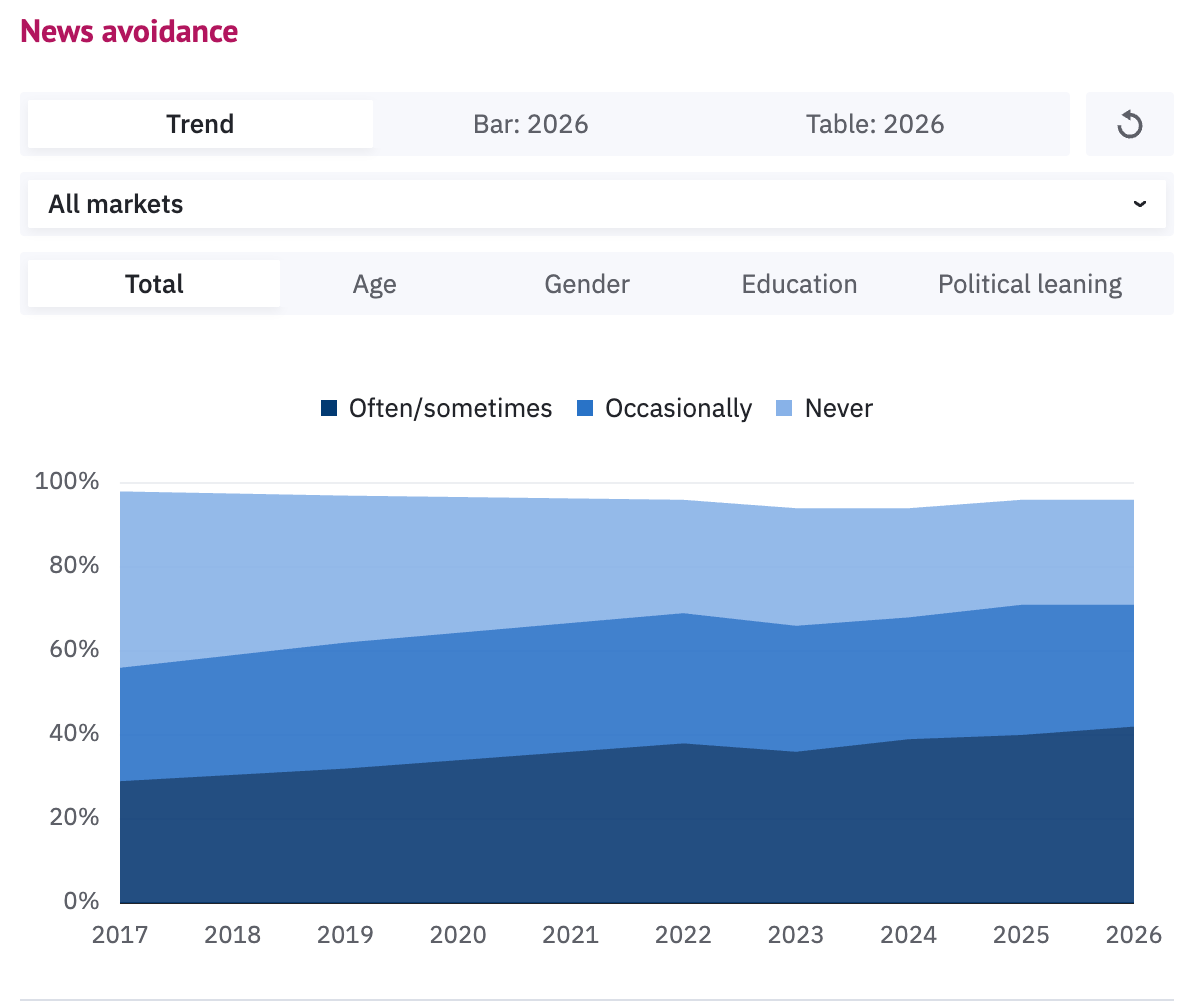
Another trend people in the biz are tracking is “News Avoidance.” Back in 2017, 42% of respondents said they never avoided the news - that number is now down to 25% - which means three quarters of the world avoids the news. In fact, 42% now say they “often/sometimes” dodge news. Up from 29% in 2017.
Perhaps not surprising either (these are global numbers), but it’s a pernicious trend. People are leaving the traditional news sources - TV and Print. They are exhausted, I’d say, not just by the world (it’s always sort of sucked) but by the way news is presented online. Confrontational. Biassed. Incomplete. Rage-inducing.
The rise of AI chatbots is problematic, of course - they are basically stealing journalism to present as a finished product to their end users. But if you look at it as a consumer, it makes sense - I do find myself fact-checking stuff I see online, and, with the right prompts, I can often get to the bottom of a story more quickly than an old-fashioned Google search.
Personally, this new world has opened up a whole new seam of opportunity. I have a standard onboarding process for new clients (creators and organizations) for our digital business, and it turns around a few questions:
Gatekeepers at scale are largely gone. Who owns the audience you need to reach?
Who knows more about your subject than you do? People value hard-won expertise (not just hot takes), and they want information - even though traditional print and broadcast media are often ill-equipped to serve multiple specialist audiences.
Is there a value to you in serving that audience in a highly trustworthy way? In other words, could you provide high-quality, valuable, and unbiased information to replace the news desert that people often live in?
This becomes even more relevant when you talk about niches - say, the environment. Public Policy. History.
The opportunity lies in the radical lowering of production and distribution costs.
But it’s amazing to me that more organizations and individuals haven’t leapt into this space - arbitraging their expertise into the vacuum left by traditional news.
Of course, there’s lots of “opinion” masquerading as journalism, or influencer and bot-driven disinformation or just plain ignorance.
But, given you can launch and run a global weekly TV show for a year for the price of a single mid-level staff member - why aren’t there more of these shows by engaged citizens, non-profits, thinkers and creators?
I think there’s a failure to see the building and owning of audiences as investments - that’s something that media companies have always understood.
When we prepare our regular reports for clients, I often measure the impact of the digital show(s) we do for them using a few key metrics: monthly subscribers, weekly engaged minutes, and outcomes achieved.
This last one is tricky - what is the outcome you want? It might be gaining a monthly donor or a new customer - or it might just be arming reasonable people with information that inoculates them from misinformation or hate.
Take this troubling poll for 2023 - 1 in 5 young Americans think the Holocaust didn’t happen.
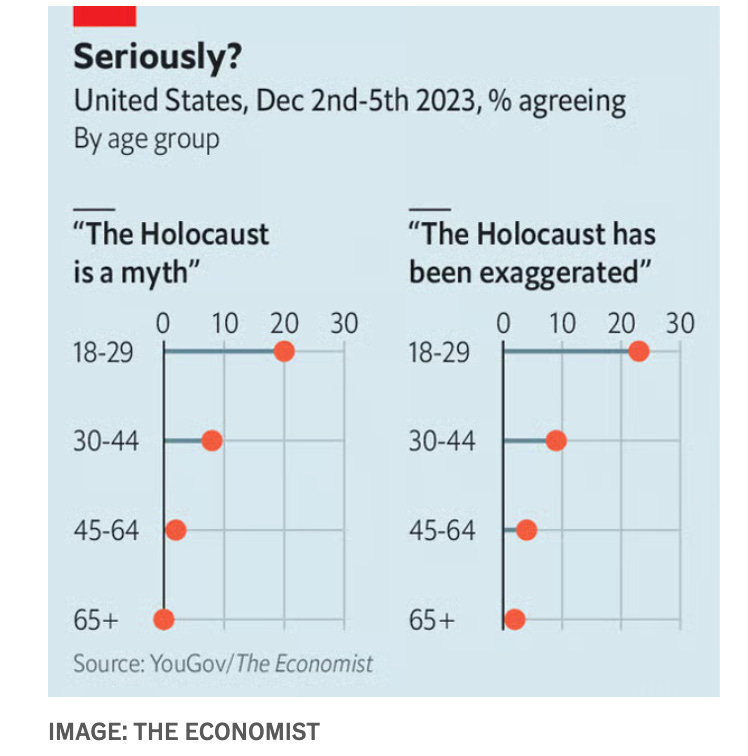
WTF? People over 65 - who knew people who lived through that time (or perhaps did so themselves) know this is BS. Why do the young not believe them?
For me, this has been the canary in the coal mine: the failure of traditional media to engage with younger people is causing a slow-motion disaster for democracy.
Pick your topic where there used to be a reasonable consensus. Measles. NATO. Foreign Aid.
Without the ability to provide a daily or weekly habit-forming conversation, you are putting lives at risk.
Hundreds of thousands of people, mostly children, died in the immediate aftermath of the sudden closing of USAID, according to multiple studies.
https://hsph.harvard.edu/news/usaid-shutdown-has-led-to-hundreds-of-thousands-of-deaths/
I think you can blame the non-profit sector as a whole for failing to educate and persuade the voting public of the value of what they do.
The good news is that, if you care about informed discussion of an issue, there is a real possibility of counteracting this trend towards ignorance and nihilism.
Think like a media company. Identify your audience. Serve them. Publish regularly. Don’t stop.
Big media isn’t coming back, but creator media can make a difference. Don’t be a victim - the global marketplace of ideas is much more wide open than you might imagine.
Yiiikes I just want to point out that there’s not enough difference between your text colour and your background colour. I had to highlight the text to read it on my MacBook. Will come back here if I have anything useful to say on the content.