Marching backwards to the future
It's not all doom - or at least not mostly

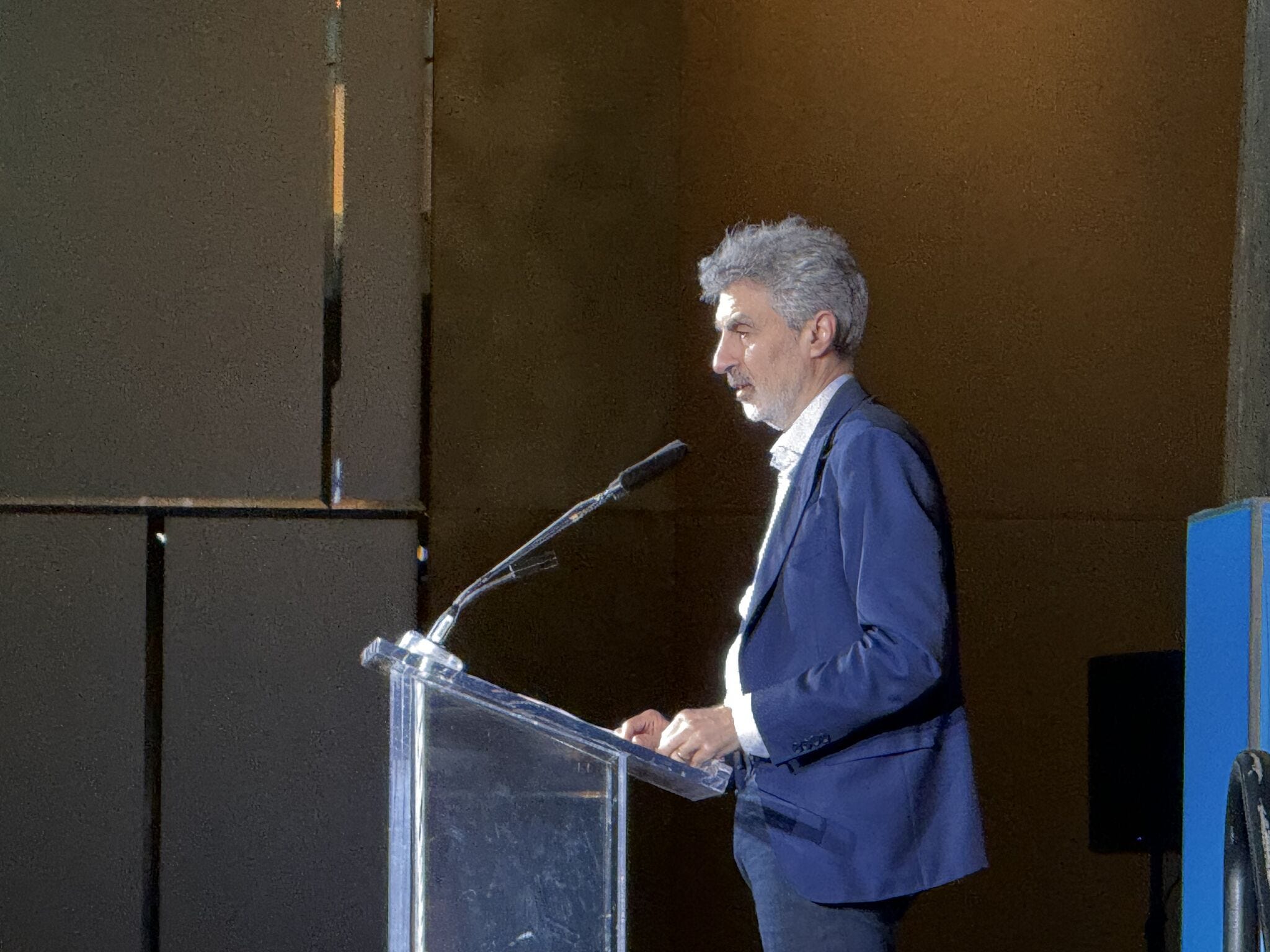
Yoshua Bengio speaking last night in Toronto.
Ran into an old journalistic acquaintance last night at the Public Policy Forum testimonial dinner reception.
About my age - has gone through many iterations of media. Still works in print, and she does work on both sides of the border now. A bit of consulting. Some TV.
How you holding up?
Well, she said, going to keep on riding this pony till it drops. Cue mournful knowing laughter. We know we are the lucky ones - still working. Still sort of relevant.
Teens and twentysomethings I know have told me they are “pre-mourning their future” - and it’s hard not to see why. Pretty much all the white noise of social and legacy media is telling them there are no jobs, the planet is burning, and whatever pleasures or privileges they currently have are some combination of unearned, transitory or not as nice as their neighbours.
Everything I’ve ever read about happiness and success comes down, more or less, to the idea of the locus of control.
If you feel, even in the worst case (think Viktor Frankl or Aleksander Solzhenitsyn in horrific death camps or Gulags), that if at least you control your mind, well, that’s a start.
At that same PPF event last night, there were a number of incredibly accomplished Canadians - from our clear-eyed former ambassador to the US, Kirsten Hillman (imagine that job over the last year?), to entrepreneurs like Arlene Dickinson and Christiane Germaine and one of the founders of AI, Yoshua Bengio.
In one way or another, they all gave a version of the same speech. The glass is more than half full, people - we have an incredible opportunity in this country to do great things. Let’s get out of our own way. Well, maybe not Bengio. He’s a bit freaked out (to put it mildly) about what he helped bring into the world. Still, he does think we have time to use it for good.
I made my own list. Here’s some relatively good news that should make us media makers and entrepreneurs prick up.
Donald Trump is not going to live forever - and besides, as Andrew Coyne expressed well this morning, there is an emerging consensus that he might have engaged in a bit of creative destruction we can all be glad for. Canadians are more aware of what we have and are prepared to invest in building something that’s not just a franchise of the US model, but maybe stronger and more independent. This applies to national projects like infrastructure and defence, but also to how we celebrate ourselves and some of our unique historical artifacts like the Crown, and how we build national champions in business, science and the arts. For us in the media in this country, it means people care about our culture more than they have in a long time. There is political will to protect institutions, “the load-bearing walls of civil society,” as Carney intoned this week.
To that end, CBC just announced an additional $7 million for documentaries. This is a bit of a drop in the bucket, but it will likely trigger at least 30 - maybe closer to 50 - new films this year. That’s the first serious cash injection in the space in, well, forever it feels like. Making documentaries is still a poverty-level pursuit - particularly if you make Canadian stories for Canadian audiences - but that’s 50 more than we had last week.
AI is terrifying - but there is a future where we don’t all become techno peasants. Lots of smart people are rallying around a model of greater data sovereignty, model control and guardrails. We are also stumbling towards humane and liberating ways to use it in the workplace. I’ve made a few stumbles at Antica lately. One colleague sent me a note this week: “Please never send me directives that have been copied and pasted from ChatGPT or Claude. I have to be frank with you, it feels insulting to my intelligence.” In another case, I forwarded some articles through a Claude search I’d found to a writer, but left the prompt that I was looking for news material to support his script’s storyline. He got the impression I was asking the AI to write his dialogue - which I wasn’t - but to say he was angry and insulted would be to put it mildly. Despite missteps (and many grovelling apologies on my part), we are all using the models every day - it seems particularly helpful for us creatives in doing things like populating Excel spreadsheets and going workback plans for projects - stuff none of us hang our identity on. (Accountants and project managers, your mileage may vary.)
We may be reevaluating the human and in-person. I’ve recently noticed a sharp uptick in people not always defaulting to Zoom - even assistants of high-powered execs will ask me if I prefer in-person. This added friction seems to be an acknowledgement that there are some things you do better face-to-face, even if you can’t quantify them exactly. This is the first year in a while that my planned business travel is going up, not down, despite rising airfare costs. Was in NYC two weeks ago and met a few people I’ve been working with online for the better part of two or three years and had never met in person. All of the meetings stretched to multiple hours and rarely touched on work directly, but they strengthened the ongoing relationship with another human being. This is good for live events (if you follow me on LinkedIn, you’ll notice I go see people speak in person or perform at least a few times a month now), and it’s good for chance, serendipitous encounters - as well as reminding us that the arts and media that we don’t toil alone. Pretty much every conversation longer than a couple of minutes becomes a bit of a group therapy session. Most of us didn’t get into this business for the money, but we do need enough money to live and do the work. It’s nice to be reminded of that shared struggle.
Social media is also a huge opportunity. I do feel more than faintly ridiculous when I make pronouncements on what kids these days are watching on reels - but increasingly, all demos are on their phones looking for content. I pull together reports for our clients, investors and sponsors on our various shows, and I’m amazed at how much genuine reach and engagement we can get (and others like us) serving communities of engagement that you just couldn’t make stuff for even a decade ago. Goalhanger - the current gold standard in podcasting - has been quite public about building its business serving fandoms that traditional media couldn’t or wouldn’t serve. The opportunities are really endless right now - and if you have media chops, you can arbitrage those skills into the creator economy more easily today than ever before.
What’s the alternative? We are imitative creatures. It’s a pretty well-established fact that your physical, spiritual and material wealth will be somewhere near the mean or average of your five closest friends. Why? Some is opportunity and class-based - for sure - but part of it is also possibility and habit-based. If your friends go to the gym every day, you’re more likely to go too. If your friends are looking for opportunities, you will be more likely to see the silver lining. Likewise, if they complain a lot, are steeped in envy, resentment and victimhood. You see the point…
What do all these things have in common?
You might be familiar with Marshall McLuhan’s “Laws of Media”. I’ve often found it a useful kaleidoscopic lens to look at how technology changes what we do in our business.
Here’s McLuhan’s example of what the mobile phone does - (from “Laws of Media: Mobile Phone”, Marshall McLuhan, from Laws of Media, 1988, page 153.)
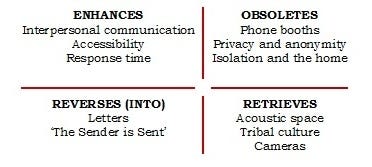
The key idea is that technology doesn’t just obsolete behaviours and industries and deliver the opposite of what it promised (think about how email didn’t so much liberate interpersonal communication as quickly turn into spam). It also retrieves lost arts and enhances existing ones.
That’s the opportunity for us all in media and the arts: our global reach is enhanced, and our very handmade human skills are being reclaimed at the same time. Someone closely reading McLuhan in 1988 would have foreseen the rise of podcasts, niche audiences and social media. As well as the birth of surveillance capitalism and the flood of demands on our time and attention.
Lots of opportunities out there in this sometimes dystopian digital world - we just have to be open to seeing them.